WARDOGS Best Optic Guide: Attachment Slots, Traps, Ranges
WARDOGS attachment guide: what the optic, muzzle, grip and magazine slots really change, verified tooltip pros and cons, and which optic to pick per range.
FAQ
What is the best optic in WARDOGS?
Do attachments matter in WARDOGS?
Are suppressors worth it in WARDOGS?
Which WARDOGS attachments should I stop using?
How do I choose an optic for range in WARDOGS?
Attachments are where WARDOGS stops being a shooter you understand. The gun decides your damage — that is all covered in our TTK and damage chart — but the workbench decides whether you can bring that gun to bear in time. Every card in it is a trade, and the game is perfectly willing to sell you a trade that makes you worse.
The trap is that the workbench reads like a shopping list. Four slots, dozens of items, all of them promising recoil reduction, and none of them telling you that the thing you just bolted on costs you a fifth of a second raising the weapon. Community testers report finding entire squads’ discarded rifles on the ground carrying exactly the same three items — a cheap vertical grip, a muzzle device and a scope you did not need for the fight you were in.
This page is not a weapon ranking and not a shopping list. It is the workbench itself: what each slot actually changes, which cards are traps, and how to pick a sight by the range you expect to fight at — built from attachment cards read off the screen at full resolution and cross-checked against two independent testers.
Source and Verification Card
| Field | Detail |
|---|---|
| Screens | Equipment Vendor → ATTACHMENTS workbench (magazine · optic · foregrip · muzzle slots) |
| Optic filter chips | ALL · SHORT · MEDIUM · LONG — read on screen |
| Cards verified frame-by-frame | Four Reticle Reflex · Tricon 1.5x Compact Prism · CQ-2X Prism Combat Scope · 6x Precision Rifle Scope · RK6 Tactical Foregrip · TDG Vertical Foregrip · Ballista Brake · TGP-A Suppressor 5.45 |
| Screenshot source | Nova Gaming — firing-range workbench on No Mans Land (AK74 and SKS) |
| Full attachment taxonomy from | Strider — grip, muzzle and optic sweep (footage carries a facecam in every frame, so no picture here is his) |
| Build example and level gate from | Sxxpr — M4 attachment list |
| Prices | Not readable. Every attachment card in the source frames reads $0 — a free-purchase range vendor, not live pricing |
| Not covered here | Which gun to buy — see the weapons list · what a first $10,000 buys — see best loadouts |

Nova Gaming — The Best Loadouts In WARDOGS (Beginners Guide): attachment workbench walkthrough
All pictures on this page come from Nova Gaming’s launch-week loadout session, which spends roughly four minutes scrolling the attachment workbench with tooltips open — the cleanest menu footage we found. The grip, muzzle and optic taxonomy is Strider’s, from a far more complete sweep of the same menus; his footage puts a webcam box in the corner of every single frame and burns captions over the tooltips, so it is credited for its explanations only and contributes no images. Sxxpr contributes one tested build and the level gate behind it.
Step 1: Understand That You Are Filling Four Slots, Not Buying Upgrades
Open EQUIPMENT VENDOR → EQUIPMENT, and each weapon slot — AK74, SIDEARM, BINOCULARS — carries its own pair of buttons: AMMO and ATTC. Hit ATTC. and the ATTACHMENTS panel opens as a row of slots above a grid of options. On the AK74 that row starts with a filled magazine tile carrying key badge 1 (the weapon slot beside it reads 30/30), then an optic slot, a foregrip slot and a muzzle slot. The selected slot is outlined in orange; a slot marked with a large X is not available on that weapon.
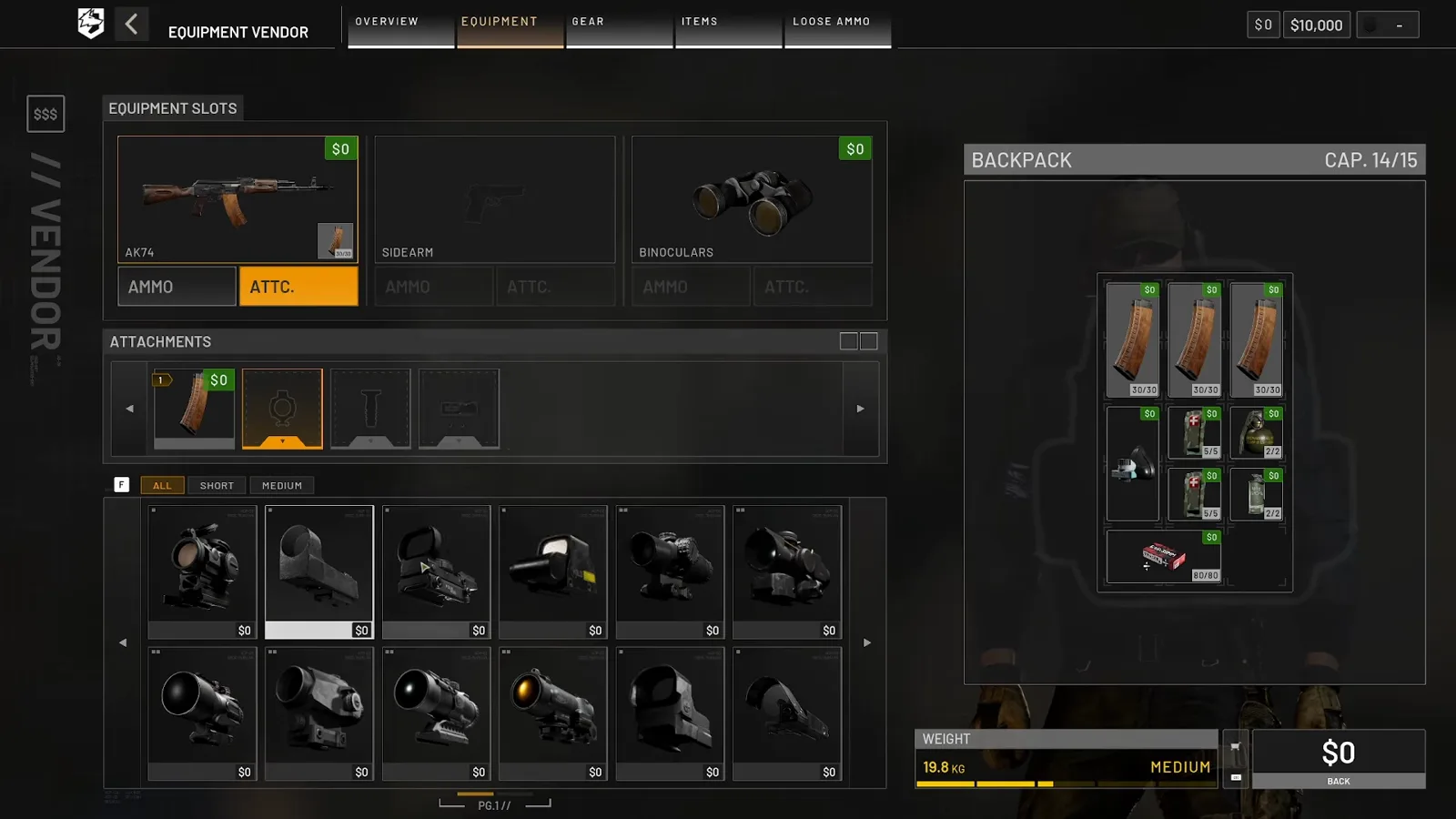 Step 1 (Timestamp: 05:40) — Four tiles, four decisions. The magazine is a container you fill, not a stat stick; the other three are pure trade-offs, and the filter chips under them already sort optics by range.
That distinction matters more than it looks. The magazine slot changes what you carry and how often you stop to reload — the reserve math is in our ammo and resupply guide — while the optic, foregrip and muzzle slots change how the gun handles. Two of those three will usually cost you speed.
Watch the workbench layout (05:40)
Step 2: Buy The Sight First, And Read Its Handling Line Before Its Zoom
Every optic card we read has a Specification block and a Pros or Cons block. The Four Reticle Reflex says 1.2x magnification · Close range combat · Fixed zeroing, then Pros: Moderate ADS speed improvements, then a line that gives the whole game away in its own prose: “Slightly slower to aim, but offers adaptable targeting for close/mid engagement ranges.” Weight 0.12 kg.
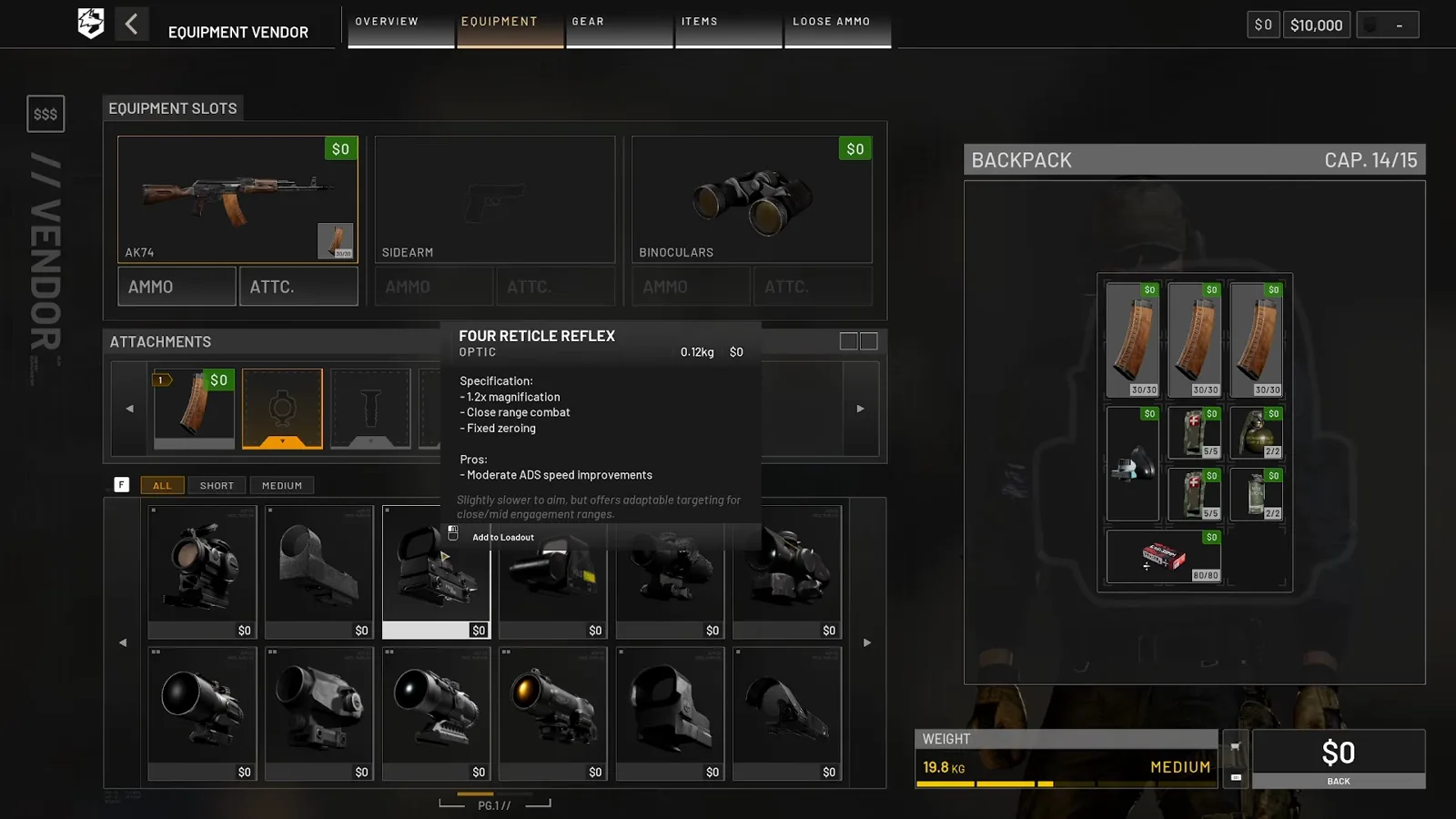 Step 2 (Timestamp: 05:48) — This is the card to beat: magnification plus a handling improvement instead of a handling tax. Nova calls it his favourite for exactly that reason, and prices reflex sights at a reported $300-600 — the only attachment money he says is almost always well spent.
Nova’s argument is the one to follow: iron sights in WARDOGS are clean and unobstructed, but ADS speed is slow in this game, so the sight you buy is buying you time-to-aim, not pixels. Magnification is “nice, but not necessary.” Strider reaches the same place from the opposite direction — his complaint about bad builds is that they stack a high-zoom optic on top of a slow grip and a muzzle device, and the result crawls out to full aim.
Watch the Four Reticle Reflex card (05:48)
Step 3: Know What A Red Dot Is Actually Buying You
A reflex sight does not give you reach. It gives you an unobstructed 1.2x window you can bring up fast, and the difference between that and iron sights is mostly how quickly the reticle is on target after you press the aim key.
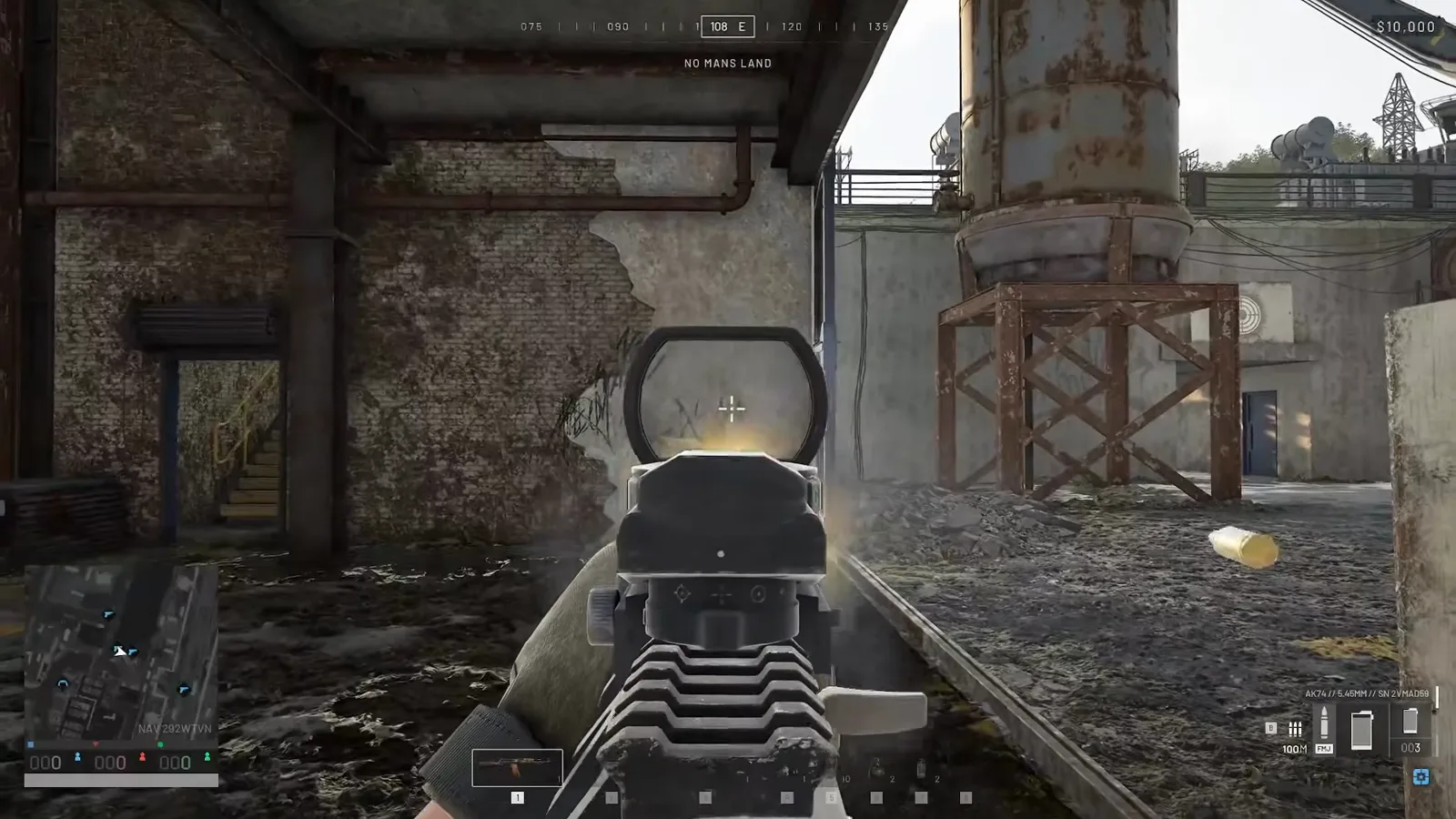 Step 3 (Timestamp: 06:06) — The whole point of the low-power class: a fast, clear window with the weapon still shooting where the reticle sits. Everything above 2x starts costing you that.
Strider’s tour of the red-dot class is useful for what it warns against rather than what it recommends: the OKP-7 and the Cobra are both sights he calls good but pretty bright, the Compact T-2 “very obstructive but really not a bad sight for the price,” and he notes the same pattern the cards confirm — several of these dots are chosen specifically because they grant a moderate ADS speed improvement. Brightness and housing obstruction cannot be measured from a compressed video frame, so treat those as one tester’s impression, not a spec.
Watch the reflex sight in use (06:06)
Step 4: Stop Buying The Cheap Vertical Foregrip
This is the single most common attachment mistake in the footage, and the card proves it. The RK6 Tactical Foregrip is the one Strider opens with because it is the cheapest, and it is the one he tells you to stop using.
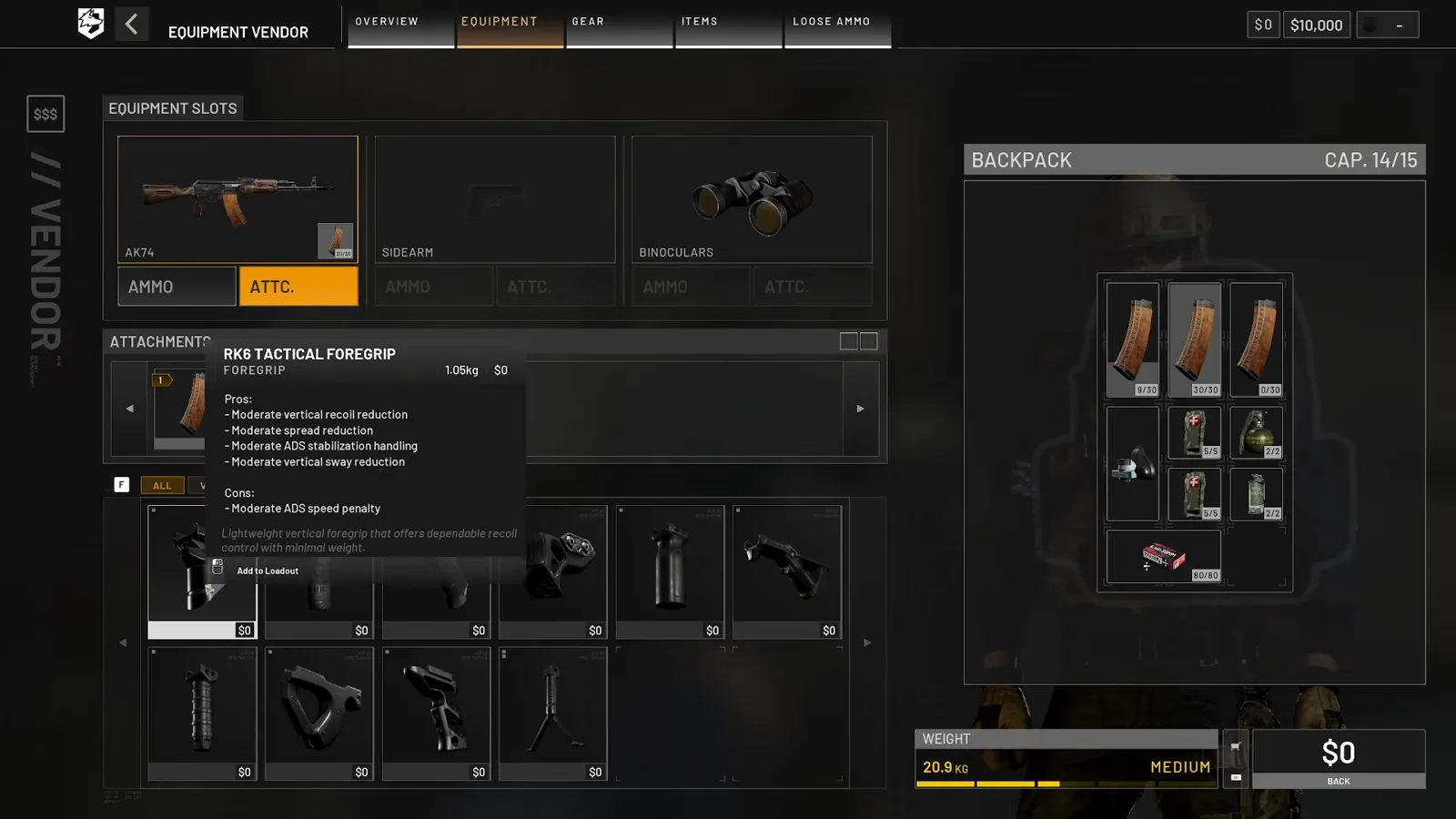 Step 4 (Timestamp: 06:33) — Read the numbers, not the prose. Four “moderate” benefits, one handling penalty, and a weight figure that flatly contradicts its own description.
Two things are wrong with it, and only one of them is obvious. The obvious one is the trade: Moderate ADS speed penalty for moderate vertical recoil reduction, moderate spread reduction, moderate ADS stabilization handling and moderate vertical sway reduction. Strider’s range test adds the part the tooltip hides — the vertical recoil does improve, but because the horizontal figure is unchanged while the pattern is compressed, the trace gets squashier, and a side-to-side wobble is harder to compensate for than a predictable climb.
The second is on the card itself: it weighs 1.05 kg and its description calls it “a lightweight vertical foregrip that offers dependable recoil control with minimal weight.” The TDG below weighs 0.13 kg. Either the weight column or the flavour text is wrong in the launch build — we cannot tell which — and that is worth knowing before you let a tooltip’s prose make a purchase decision for you.
Step 5: If You Want Vertical Control, Pay For The Strong Version
The TDG Vertical Foregrip is the same idea done properly, and both testers independently land on it as the best grip in the game — Nova calls it “probably the best grip in the game,” with the CQR front rail grip “slightly better.” Strider prices it at a reported $1,000.
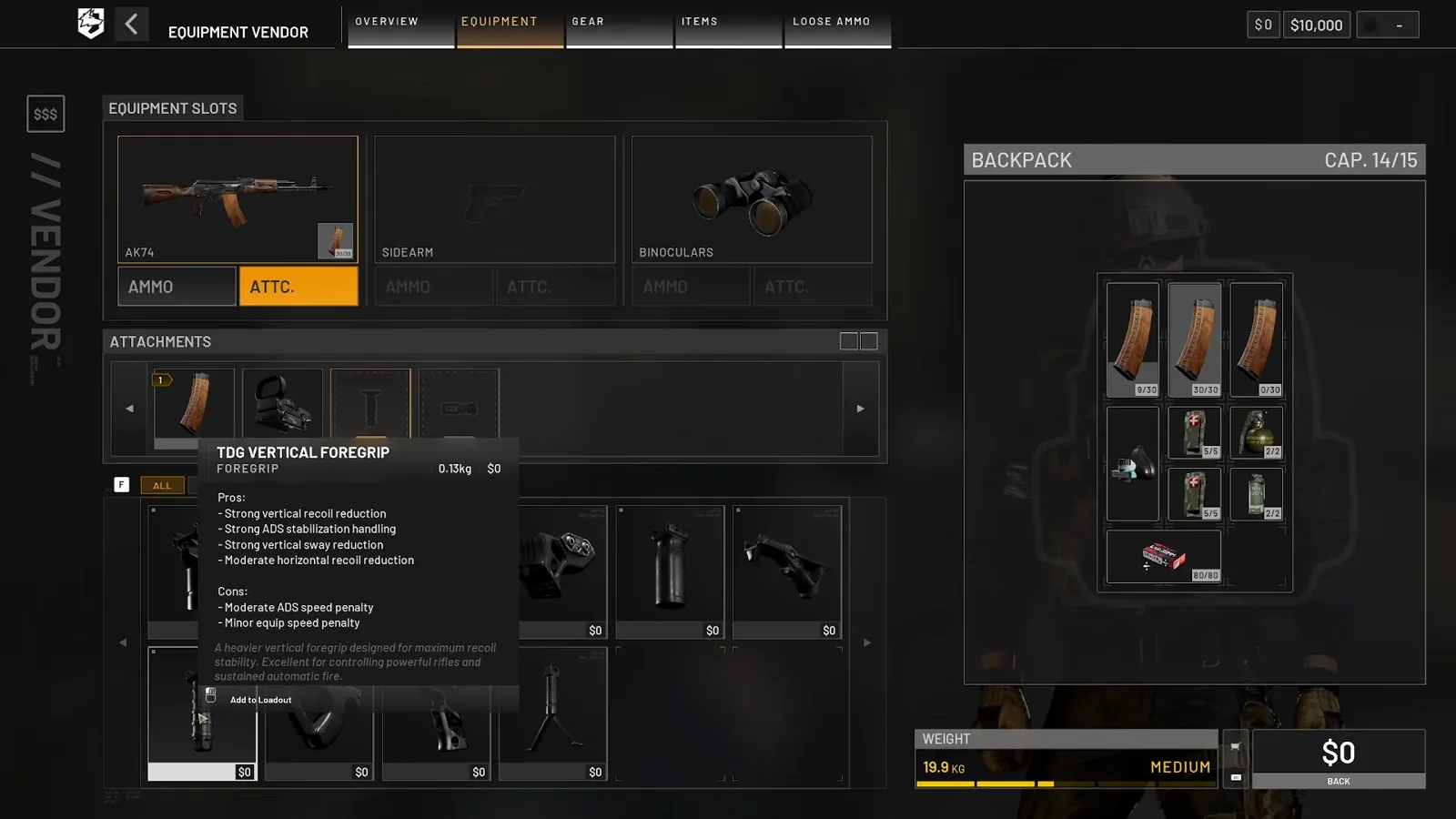 Step 5 (Timestamp: 06:56) — Strong where the RK6 is moderate, at an eighth the listed weight — and it is honest about the price: you now draw your weapon slower as well as aiming slower.
The description is explicit: “A heavier vertical foregrip designed for maximum recoil reduction. Excellent for controlling powerful rifles and automatic fire.” The Cons block is the one to respect: Moderate ADS speed penalty and Minor equip speed penalty. That second line is what Strider turns into a field rule — if you swap to an RPG, a wrench, binoculars or a viewfinder mid-fight, a grip that slows equip speed is taxing your whole kit, not just your rifle. Spotting with binoculars to bank recon XP is covered in our XP leveling guide.
The angled grips are the counter-argument, and they may be the better buy
Strider’s sweep favours a different direction entirely. The 45-degree angled foregrip gives moderate horizontal recoil reduction, moderate spread reduction and — crucially — ADS speed improvements plus equip speed improvements: it makes you faster, not slower, at the cost of slightly higher vertical climb. The mini angled grip he describes as having “only pros”: strong horizontal recoil reduction, moderate spread reduction, and the same two speed improvements. The Shift foregrip is the expensive version — strong horizontal, strong spread, moderate ADS and equip speed improvements. His reasoning is that vertical recoil is something you already fix by pulling your mouse down, so paying for it with handling is a bad deal; buying horizontal control and handling is the better trade. Nova disagrees on the principle but not the mechanics: he finds most launch-era rifles so vertical that horizontal reduction is not worth much. Both readings are printed here because both are defensible — take the angled route if your aim discipline is good, the TDG if it is not.
Step 6: The Muzzle Slot Is Where The Worst Money Gets Spent
Nova’s verdict on this slot is blunt: with recoil not being the binding constraint on most guns, “you don’t really necessarily need a muzzle break. So I would save your money on it — at least until you’ve unlocked the suppressors.” The one muzzle device he and Strider both like is not a recoil tool at all.
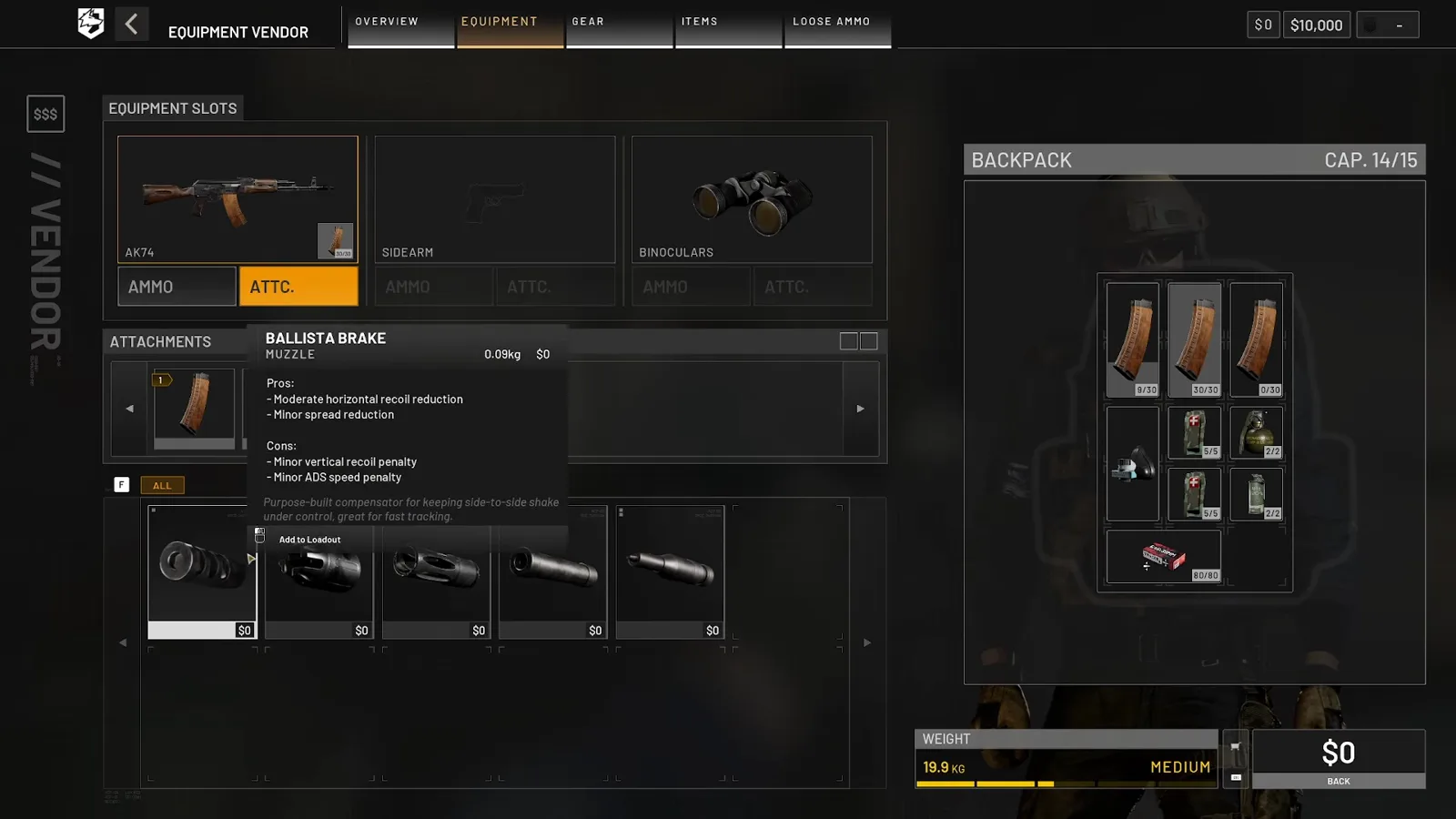 Step 6 (Timestamp: 07:07) — A compensator that costs you vertical recoil to buy you horizontal control and tracking. On an SMG Strider calls it “way better than you’d expect”; on an AR it is a niche purchase.
The Ballista Brake is the clearest example of why you read the whole card: Pros moderate horizontal recoil reduction, minor spread reduction; Cons minor vertical recoil penalty and minor ADS speed penalty, at 0.09 kg. Strider expected it to be bad because it charges you handling and vertical recoil, measured the vertical penalty at 0.5%, and ended up recommending it on SMGs. The hexagon brake he describes as the stronger version — much better horizontal, slightly better spread, no vertical downside, but an ADS speed penalty. Flash hiders sit at the other end: flash reduction plus ADS speed improvements, no recoil effect at all.
Watch the Ballista Brake card (07:07)
Step 7: A Suppressor Is Worth It For The Flash, Not The Silence
The secondary question behind “wardogs suppressor worth it” has a clean answer once you read the card. The TGP-A Suppressor 5.45 is the most generous muzzle item we verified.
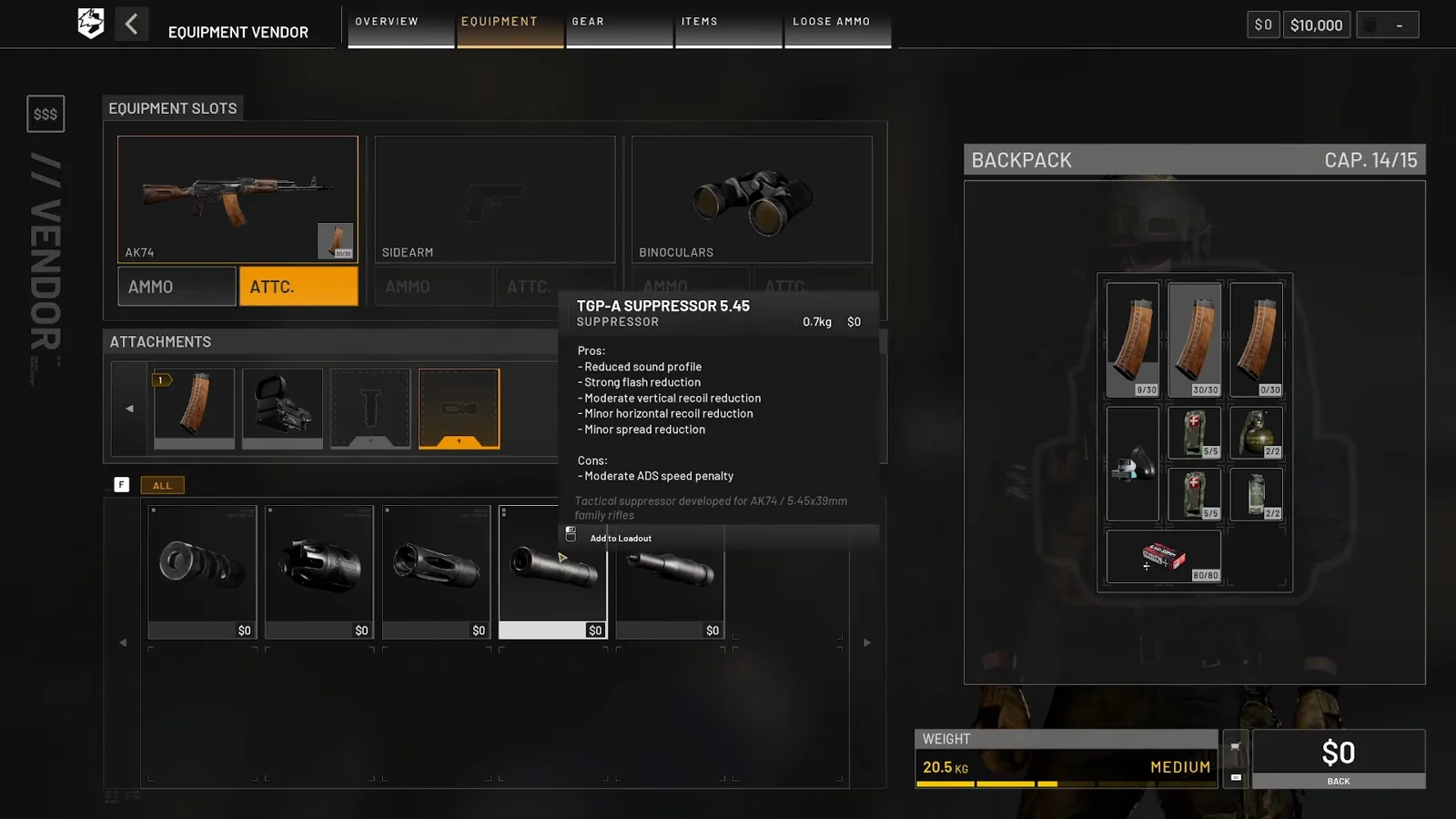 Step 7 (Timestamp: 07:11) — Five pros against one con, and the con is the same one every other muzzle device charges: moderate ADS speed penalty. Note the caliber lock in the description — this one is for the AK74 / 5.45x39mm family.
Pros: reduced sound profile · strong flash reduction · moderate vertical recoil reduction · minor horizontal recoil reduction · minor spread reduction. Cons: moderate ADS speed penalty. 0.7 kg.
Now the honest caveat, and it is the reason the “stealth” pitch does not hold. Strider’s objection to suppressing anything in this game is that there is no subsonic ammunition, so a suppressed rifle is quieter but nowhere near silent — he wants a VSS or an AS Val before the category means anything. His read on the caliber-specific 5.56 can is that it trades a little more recoil reduction for a little more ADS speed penalty. What the flash reduction buys you is not invisibility; it is your own sight picture staying clear, and not lighting yourself up as a target. Nova reaches the same conclusion from the other side — suppressors are the one muzzle unlock that “can make a huge difference.”
One more gate worth knowing: Sxxpr’s M4 build is level-gated, not just cash-gated. He notes the rifle itself unlocks at assault level 20 but his build “requires level 22 just because you’re using the multi-caliber suppressor” — a separate, cross-caliber suppressor item. Treat that as one tester’s report, but check your assault level before you plan a build around a muzzle device.
Watch the TGP-A Suppressor card (07:11)
Step 8: Pick Magnification From The Filter Chip, Not The Number
Here is the part of the workbench that answers the actual question behind “wardogs best optic”: the game already sorts its sights for you. Scroll the optic slot and the filter chips read ALL · SHORT · MEDIUM · LONG, and each card’s own Specification block names the range band it belongs to.
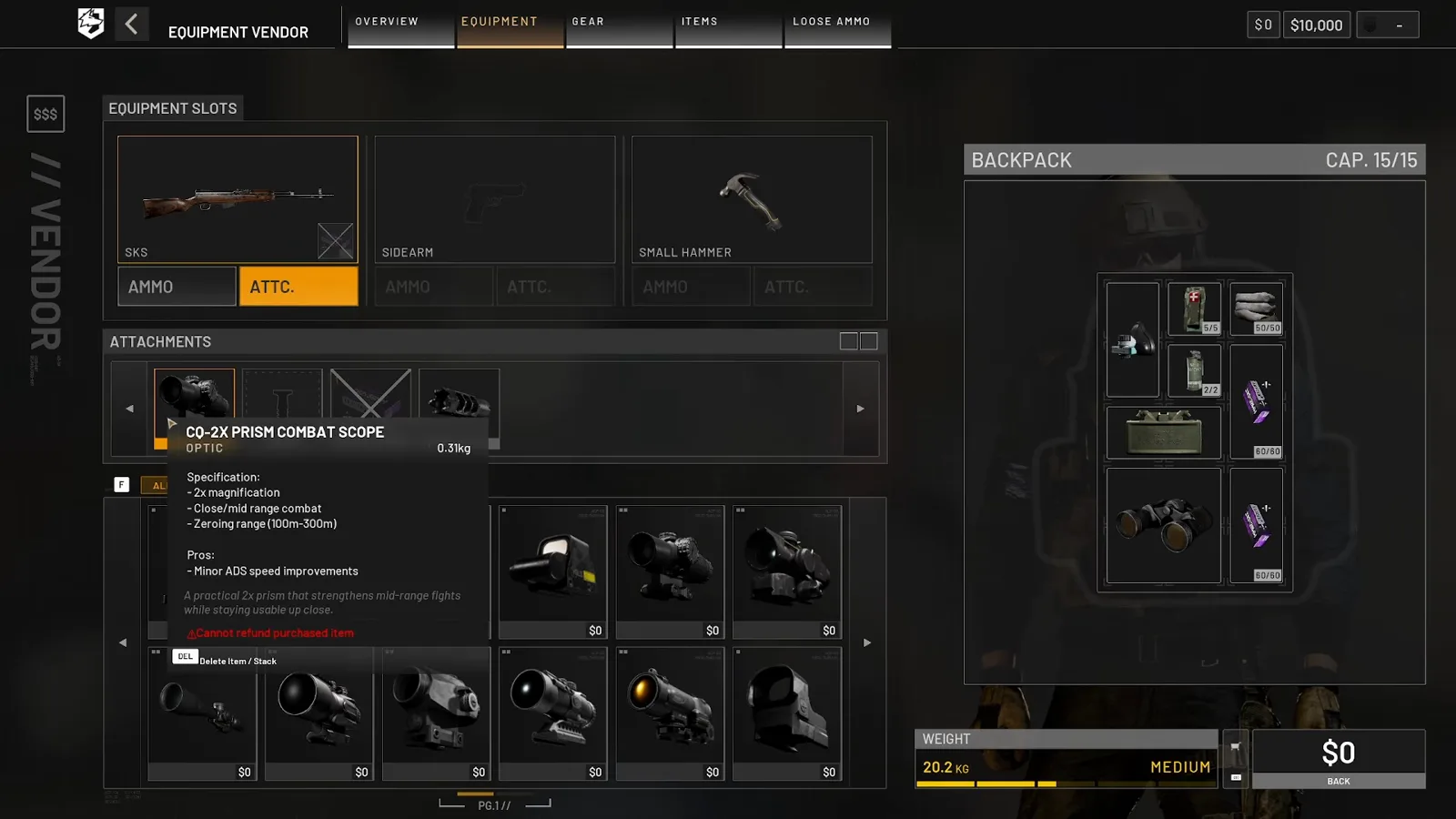 Step 8 (Timestamp: 07:25) — The middle rung, and the one Nova puts on his SKS: 2x with a 100m-300m zero, and still an ADS speed improvement rather than a penalty. At 0.31 kg it is lighter than the suppressor.
The ladder we could read cleanly runs Four Reticle Reflex (1.2x, close, fixed zeroing) → Tricon 1.5x Compact Prism (1.5x, close/mid, 100m-200m, minor ADS speed penalty) → CQ-2X Prism Combat Scope (2x, close-mid, 100m-300m) → 6x Precision Rifle Scope (6x, long range combat, 100m-600m, 0.7 kg). The Tricon’s description is the most useful sentence on any optic card: “A light optic for players who want a little magnification without sacrificing close-range feel.” Sxxpr’s whole M4 build is built on that 1.5 prism, and Strider’s is too — he calls the 1.5 combat optic “honestly an amazing-looking sight.”
Above that, Strider’s long-range shelf includes a 6x, a 3-6x LPVO whose zoom you can set anywhere in the range but which carries a strong ADS speed penalty, a marksman scope with a red dot mounted on top for close-in use, 6-10x options in two reticles, and a 2.5-10x precision scope with a hold-breath. We could not verify those cards frame-by-frame, so they are listed as one tester’s inventory rather than as specs.
Step 9: Check What You Are Actually Buying Before You Commit Cash
Magnification is not free, and the honest way to decide is to look down the scope you are considering and ask whether you can still find a target in it.
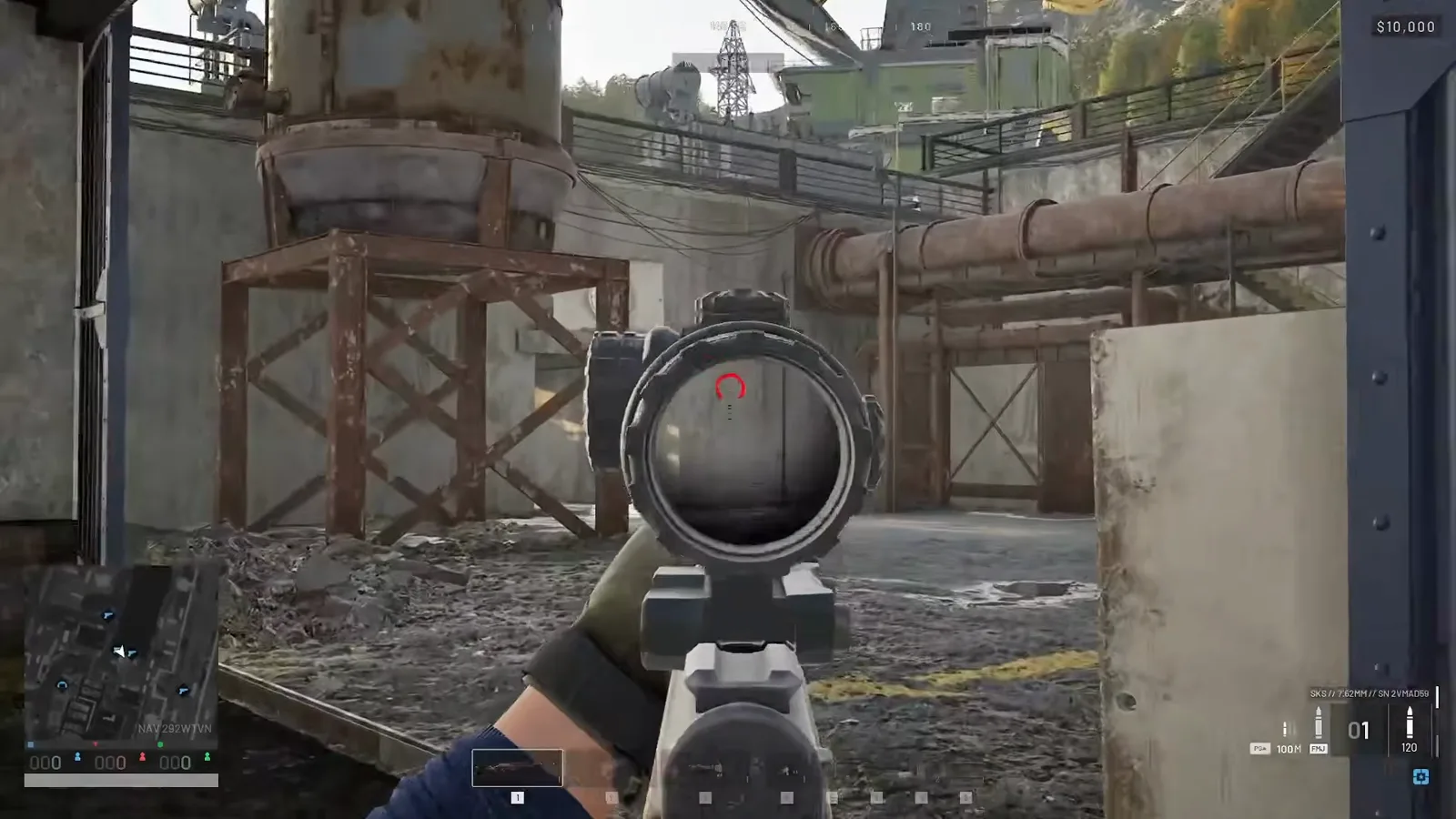 Step 9 (Timestamp: 07:43) — Reach, and the tunnel vision that comes with it. Everything outside the tube is gone, which is precisely why the workbench sorts sights by range instead of ranking them.
Strider’s dismissal of the extreme end is worth quoting in spirit: if you are sniping from a million metres and helping no objective, that is your business. The practical version of that judgement is a range question, not a preference question — read the zones and how far you actually engage in our maps and tactics guide, then buy the smallest optic that covers it. If you are building around a long-range sight at all, the SKS route and its recon leveling are in our recon sniper unlock walkthrough, and the rest of the money decisions belong on the beginner guide.
Watch the scoped rifle downrange (07:43)
Optic Ladder: Verified Cards By Engagement Range
| Optic (card read on screen) | Magnification | Stated role | Zeroing range | Handling effect | Weight |
|---|---|---|---|---|---|
| Four Reticle Reflex | 1.2x | Close range combat | Fixed zeroing | Pros: Moderate ADS speed improvements | 0.12 kg |
| Tricon 1.5x Compact Prism | 1.5x | Close/mid range combat | 100m–200m | Cons: Minor ADS speed penalty | not legible |
| CQ-2X Prism Combat Scope | 2x | Close-mid range combat | 100m–300m | Pros: Minor ADS speed improvements | 0.31 kg |
| 6x Precision Rifle Scope | 6x | Long range combat | 100m–600m | not legible | 0.7 kg |
Attachment Cards: Verified Pros, Cons And Weight
| Item | Slot | Pros | Cons | Weight |
|---|---|---|---|---|
| RK6 Tactical Foregrip | Foregrip | Moderate vertical recoil reduction · moderate spread reduction · moderate ADS stabilization handling · moderate vertical sway reduction | Moderate ADS speed penalty | 1.05 kg |
| TDG Vertical Foregrip | Foregrip | Strong vertical recoil reduction · strong ADS stabilization handling · strong vertical sway reduction · moderate horizontal recoil reduction | Moderate ADS speed penalty · minor equip speed penalty | 0.13 kg |
| Ballista Brake | Muzzle | Moderate horizontal recoil reduction · minor spread reduction | Minor vertical recoil penalty · minor ADS speed penalty | 0.09 kg |
| TGP-A Suppressor 5.45 | Suppressor | Reduced sound profile · strong flash reduction · moderate vertical recoil reduction · minor horizontal recoil reduction · minor spread reduction | Moderate ADS speed penalty | 0.7 kg |
Reported, Not Verified On Screen
| Claim | Source | Status |
|---|---|---|
| Reflex / red-dot sights cost roughly $300-600 | Nova Gaming | Community-reported — every card in our frames reads $0 |
| TDG Vertical Foregrip costs $1,000 | Strider | Community-reported |
| 45-degree and mini angled grips grant ADS and equip speed improvements | Strider | Community-reported — grip names match his, cards not read frame-by-frame |
| No subsonic ammunition exists, so suppression is partial | Strider | Community-reported, consistent with the ammo guide finding only FMJ / HP / AP |
| M4 unlocks at assault level 20; a multi-caliber suppressor needs level 22 | Sxxpr | Community-reported, single tester |
| Shotgun full choke tightens buckshot materially; slugs are rifled but still spread | Strider | Community-reported |
| Optic cards exist above 6x, including a 3-6x LPVO with a strong ADS penalty | Strider | Community-reported inventory, unverified |
Attachment Rules Of Thumb
- Buy the sight before anything else. It is the only slot where a card hands you a handling improvement instead of charging you for one. Everything else on the workbench is a trade.
- Read the Cons line first, every time. Recoil reduction is the headline; ADS speed penalty, equip speed penalty and weight are the price, and the price is what kills you in a fight you did not expect.
- Do not stack three handling taxes on one rifle. Cheap vertical grip + muzzle device + high-zoom optic is the combination testers report finding abandoned on the ground. Any two of those is already a slow weapon.
- Take the smallest optic that covers your range band. Use the SHORT / MEDIUM / LONG chips as the answer rather than as a suggestion — the cards inside each chip already match the ground they are built for.
- Prefer horizontal control over vertical control. Vertical is fixable with your mouse; a side-to-side wobble is not. That is the argument for the 45-degree and mini angled grips over any vertical foregrip, and the reason the Ballista Brake is better than it looks.
- Buy a suppressor for the flash, not the stealth. No subsonic ammunition exists yet, so the sound benefit is partial. The strong flash reduction is the line that actually wins you fights.
- Check the caliber before the muzzle. The TGP-A card names its platform outright — AK74 / 5.45x39mm family. A suppressor is not a universal part, and a cross-caliber unit may be level-gated as well as priced.
- Do not trust a tooltip’s prose over its numbers. A grip described as lightweight that weighs eight times what the “heavier” one weighs is a bug in the launch build, not a hint. Weight, Pros and Cons are the data; the italic line is decoration.
- Weight is a real budget on a real loadout. Attachment kilograms stack with magazine and reserve-ammo kilograms, and heavy slows how you move — the slot economics are worked through in our best loadouts guide.
Attachment cards were transcribed frame-by-frame from Nova Gaming’s launch-week firing-range workbench session on No Mans Land, at full resolution and with tooltips open — that is the source of every Pros, Cons, Specification, zeroing range and weight figure printed above. The wider grip, muzzle and optic taxonomy, including the angled-grip argument and the no-subsonic-ammo objection to suppressing anything, is Strider’s; his footage carries a webcam box in every frame and a burned caption over one tooltip, so it contributes no images and is credited for its explanations only. Sxxpr contributes one tested M4 build and the assault-level gate behind its suppressor. Prices are deliberately absent: every card in the verified frames reads $0. Where testers disagree — vertical versus angled grips, whether horizontal reduction is worth buying at all — both readings are printed and the disagreement is named. Early-Access balance moves fast; re-check the cards after each patch.
Related videos


Related Articles
fixes
WARDOGS Server Browser Not Working or Empty: Fixes
WARDOGS server browser empty or not working? Patch 0.11 split the Official and Community lists. Work this ladder: check the tab, clear filters, test server side.
guides
WARDOGS Ammo Guide: Loose Rounds, Resupply and Ammo Types
WARDOGS ammo guide: loose rounds versus magazines, combining ammo on C, resupplying at the Kodiak or FOB, and what FMJ, HP and AP really do to armor.
guides
WARDOGS How to Buy a Vehicle: Vendor, Gates and Spawn
Step-by-step WARDOGS guide to buying a vehicle: find the vehicle vendor stall, read the Driver and Pilot level gates on each card, pay, then spawn and lock it.
Was this helpful?
Thanks for the feedback!